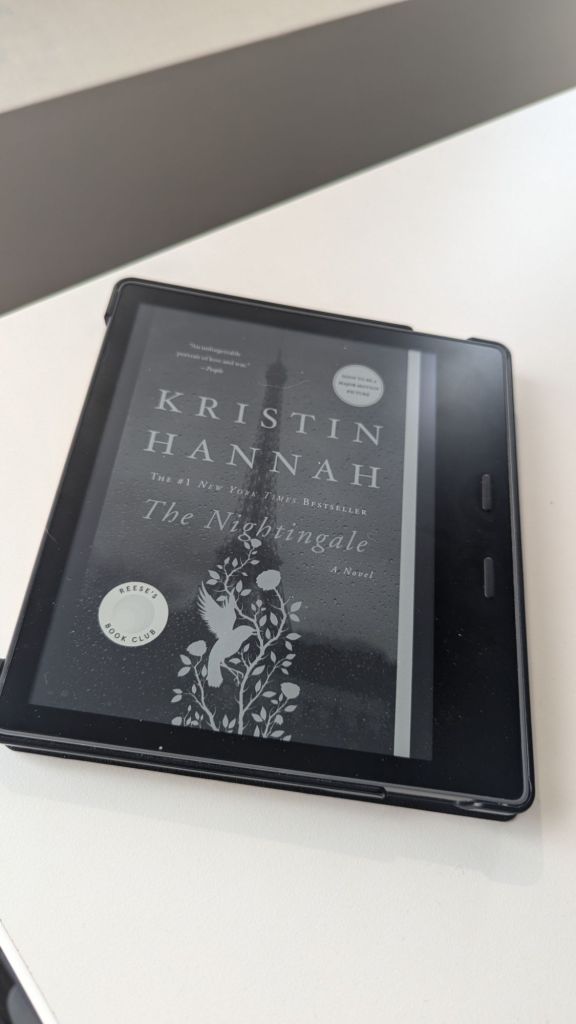
Kristen Hannah’s THE NIGHTINGALE follows a pair of sisters during Germany’s occupation of France in the midst of the Second World War. One sister, Isabelle, refuses to sit idly by and allow the enemy to operate without opposition whereas the other sister, Vienne, must resort to doing everything possible to keep her daughter Sophie safe; even if that means living with the enemy in her home. I don’t want to say too much about this book as I’m fearful of spoiling the plot and the developments that go along as the story progresses.
A few years ago, I had to step back from both fiction and non-fiction surrounding World War Two due to being completely overwhelmed by the atrocities that took place in the concentration camps and the inhumanity shown on the part of the Nazi regime. While I didn’t expect that I would grow numb to what I was reading, it never got any easier. As this was chosen as the first selection of a newly established book club at my office, it looked like I was set to return to 1940s Europe once again. This time around, it was from a perspective that I don’t believe I’d read before. It wasn’t so much at the front lines, nor was it entirely within a concentration camp, but more so a look at ordinary citizens living in occupied territory. The food scarcity coupled with the gradual stripping of rights of the Jewish people were tough to read about, but certainly puts into perspective the troubles in my modern life and how I’ve personally never known such hardship.
In Vienne and Isabelle, Kristen Hannah has created profoundly powerful women who did everything within their power to attempt to make it through the war even if they always knew that the person who came out on the other end of the conflict would never resemble the person before the German army marched into France. As the novel progresses, their evolutions are both deeply heartbreaking and intensely inspiring. I expect that I’ll think about both for years to come.
This isn’t a perfect novel, despite the deluge of five star reviews you can read. There’s some moral ambiguity in that the author paints a Nazi commander in a sympathetic light, which I struggled with quite a bit and feels very much like a “not all Nazis” were bad sort of way. I get that it is necessary to juxtapose one situation with another which arises later in the novel, but I still feel weird about it and a bit manipulated.
Despite that, I believe it is definitely worth reading and one that I wholeheartedly recommend. Don’t listen to the reviews that say that the “romance” sort of downplays the atrocities and the seriousness of the war. Those who fought in the war did so out of both moral obligation and the hope for a better world once all was said and done. And is there nothing more romantic than hope?
 Every Read Thing