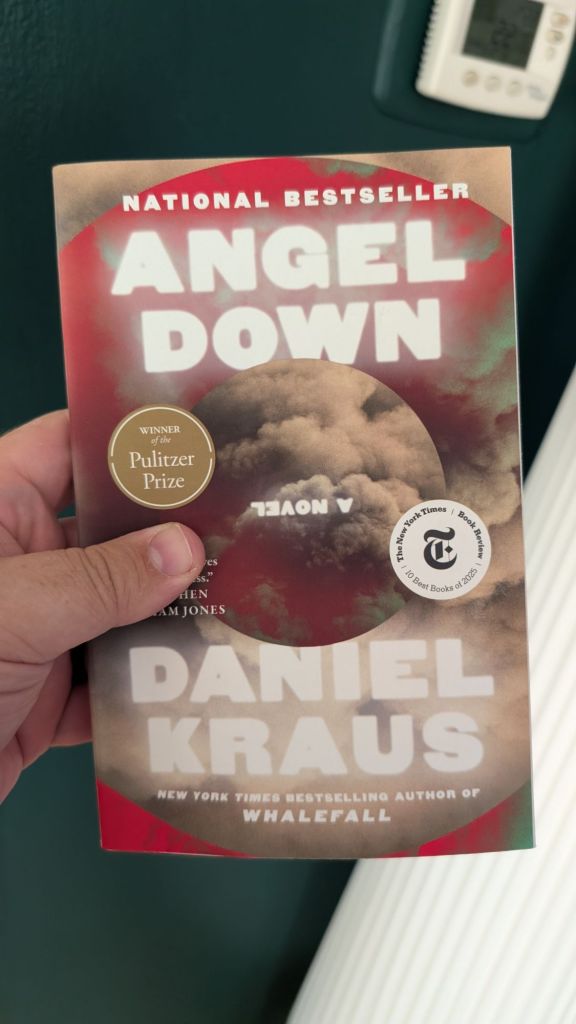
ANGEL DOWN follows Private Cyril Bagger, and four of his fellow soldiers, on the front lines near the end of the first World War. The five men are sent to investigate incessant screaming from outside of their trench to the middle of no man’s land. Upon discovery, the troop uncovers what appears to be a fallen angel caught under barbed wire. Could she be the key to the end of this brutal conflict? Or will she tear the contingent apart?
Oh boy, this was an interesting read. I will admit, despite having read and enjoyed Daniel Kraus in the past, I was mostly drawn in by the rather gimmicky idea of writing a novel in one continuous sentence. I had wondered if the format would become tiresome or that it would wear out its welcome rather quickly. Because of those preconceived worries, it had sat on a literary backburner since last year’s release. However, given that it just nabbed the 2026 Pulitzer Prize, that was seemingly all the reason I needed to bump it to the top of my to-read list.
Thankfully, the continuous sentence construct worked really well here. It certainly helps that it’s used in the context of World War I, one of history’s most violent conflicts. Prior to this book, my only real literary exposure was All Quiet On The Western Front and while I loved that book, it generally kept me away from exploring more fiction surrounding the Great War given its grisly narrative. And much like Erich Maria Remarque, Kraus pulls no punches in his novel. ANGEL DOWN is just about as grotesque and horrific as you can imagine, and when you add in the frenetic pacing of Kraus’ run-on sentence storytelling, you’re left breathless at times. There is certainly a lot of imagery I’m unlikely to forget anytime soon, and might pose some trouble for those who cannot deal with animal death.
I won’t spoil anything here, but the ending is rather ambiguous and would absolutely benefit from reading this as a part of a book club, or perhaps running to Reddit to get others’ thoughts when you flip the last page. That said, you’re not going to be left wondering what Kraus’ true feelings are on mankind’s proclivity for war nor the futility of its nature. There is a pretty cutting line near the end that will stick with me for years to come.


Brandon – did the mention of GPS early on in the book about WWI anger you enough to want to simply toss the book away? Or did you simply accept it as “it’s all science fiction anyway?”
Hi Rich – I must have completely missed that as I don’t recall it. That feels painfully out of place though.
Brandon – MY BAD!!! I was listening to the audiobook, and my ears are 72 years old. Sorry. I looked at it in the book, and here’s the correct version: “the long-range GPFs”.
Shoulda known before blabbing my mouth off =:-)
Oh no worries at all! I wrote a review for another website the other day and had to double and triple check what I remembered regarding specific passages. Nothing stays for long between my ears these days!